

Universities
Teach and research dry cooling on published methods
Academic holds every system and every analysis, with CFD, the CFD lab and the co-simulation, under four licences: a research seat, a department licence, a teaching licence and a student seat. Every result names the equations that produced it, each with its source, so a number can be followed back to the literature.
What DraftSolver does for universities
Universities and other accredited institutions of higher education: staff, postgraduate researchers, lecturers and students.
- Worked examples for a classKröger's worked examples ship with the app as complete cases with their expected results. A class reproduces a published calculation, then changes one input and sees what moves.
- The HandbookEach result links its equations to the Handbook: the source, the coefficients, the fitted range and the stated accuracy. A result outside a fitted range is reported as an extrapolation.
- Research on every systemEvery system and analysis, the Monte Carlo band, the Transient simulation, CFD of the same plant and the CFD lab, with the co-simulation of the CFD and the rating's own model. CFD runs on Adiabat's compute service for credits, at the price every plan pays.
- Studies by scriptA case is one JSON file, and everything the interface does goes through the app's REST API with a personal token, so a study of many cases can be scripted.
The systems it covers
Air-cooled condensers
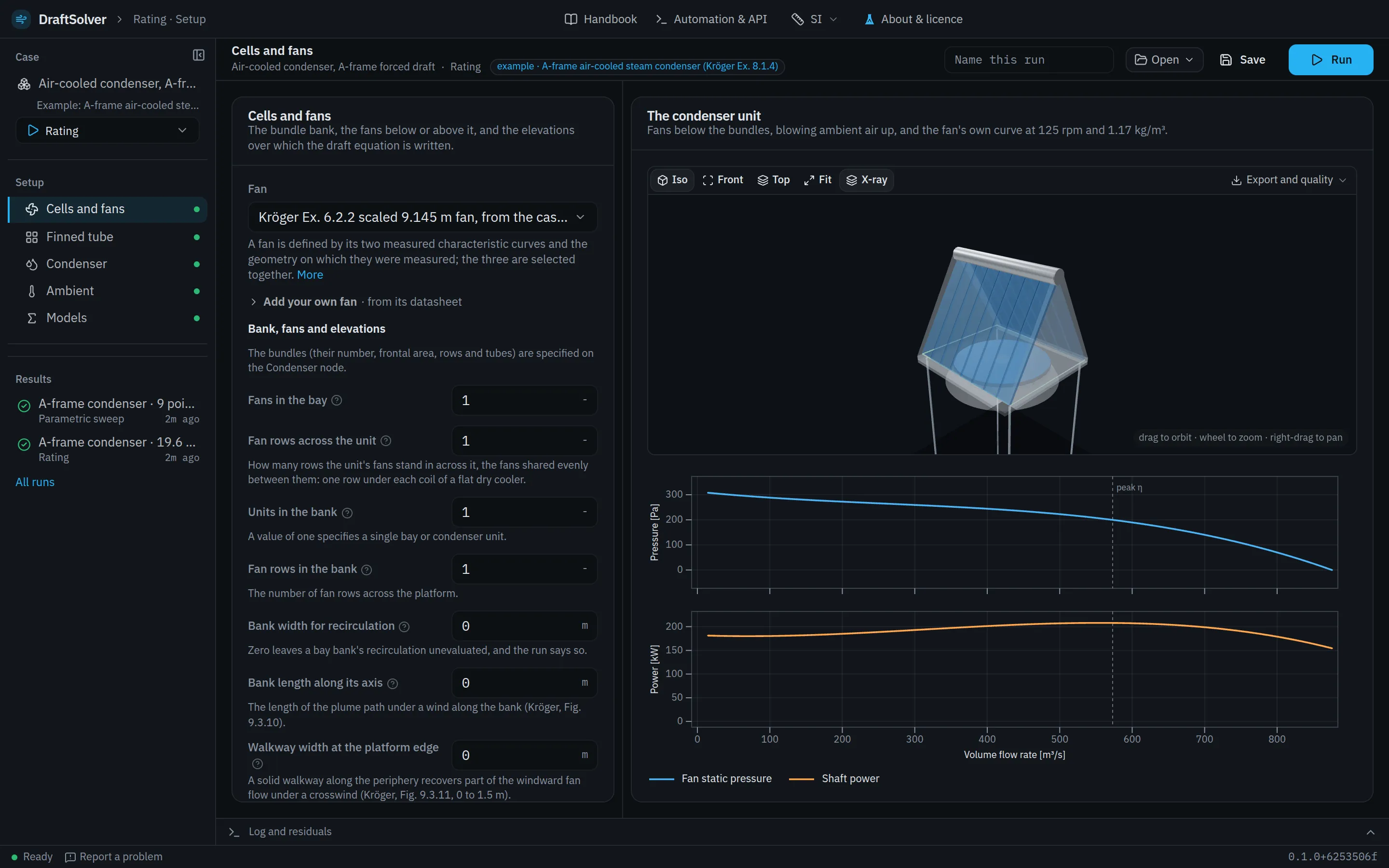
- Air-cooled condenser, A-frame forced draft
Condenses turbine exhaust steam in A-frame bundles, with fans below pushing the air through them.
- Air-cooled condenser, A-frame induced draft
Condenses turbine exhaust steam in A-frame bundles, with fans above the apex drawing the air through them.
Dry coolers
- Dry cooler, plate-fin coil
Cools water or an antifreeze solution in plate-fin coils, with fans below pushing the air through them.
- Dry cooler, plate-fin coil, induced draft
Cools water or an antifreeze solution in plate-fin coils, with fans above drawing the air through them.
Air-cooled heat exchangers
- Air-cooled heat exchanger, forced draft
Cools a process fluid in horizontal finned-tube bundles, with fans below pushing the air through them.
- Air-cooled heat exchanger, induced draft
Cools a process fluid in horizontal finned-tube bundles, with fans above drawing the air through them.
Natural-draft towers
- Direct natural draft, vertical bundles
Condenses turbine exhaust steam in finned-tube bundles standing around the base of a natural-draft tower.
- Indirect dry cooling, natural draft, horizontal array
Cools a condenser's circulating water in bundles lying in the inlet of a natural-draft tower.
- Indirect dry cooling, natural draft, vertical bundles
Cools a condenser's circulating water in bundles standing around the inlet of a natural-draft tower.
What it was compared with
The whole record is open: every case names what it was compared with, the agreement found and what that agreement shows.
- 2Measurements on operating plants
- 13Measurements on controlled rigs
- 13Textbook worked examples
- 19CFD, co-simulation and other models
Published methods, cited
DraftSolver is an independent implementation of published methods: Kröger's one-dimensional methods for air-cooled heat exchangers and cooling towers, and the published literature on natural-draft dry cooling under crosswind and through start-up, including its author's two papers below. Both papers are open access, and each validation case cites its source.
W. Strydom, J. Pretorius and R. Laubscher
Co-simulation of transient start-up performance in natural draft direct dry cooling system under varying wind conditions
Applied Thermal Engineering 300 (2026) 131471. doi:10.1016/j.applthermaleng.2026.131471
W. Strydom, J. Pretorius and J. Hoffmann
Natural draft direct dry cooling system performance at various application scales under windless and windy conditions
Applied Thermal Engineering 248 (2024) 123181. doi:10.1016/j.applthermaleng.2024.123181
The academic licences
Academic is licensed to universities and other accredited institutions of higher education, in the four forms below, for no commercial use.
| Licence | For | Use | Term |
|---|---|---|---|
| Research seat | One member of staff or one postgraduate researcher | Research that no company or state-owned enterprise funds or commissions, and its supervision | A year |
| Department licence | Up to ten named seats in one department or research group, named in the order | Its teaching and research, under the same rules as a research seat | A year |
| Teaching licence | A lecturer and the students of one course | Coursework and classes; not research, and not work that is published | The course, up to 12 months |
| Student seat | A student enrolled at the institution, confirmed by a supervisor or lecturer | Coursework, and a thesis or dissertation that no company or state-owned enterprise funds | 12 months, renewed while enrolled |
No academic licence may be used for consulting, for work done for others for a fee, or for sponsored research. Research is sponsored when a company or a state-owned enterprise funds or commissions it in return for results, a report or rights in what it produces; a bursary, a scholarship or a grant that gives the funder none of these does not make it sponsored. Sponsored work runs on commercial seats or a project licence. Academic outputs are marked not for commercial use, and credits cost the same as on every other plan. Clause 4 of the terms of service sets out the rules in full.